


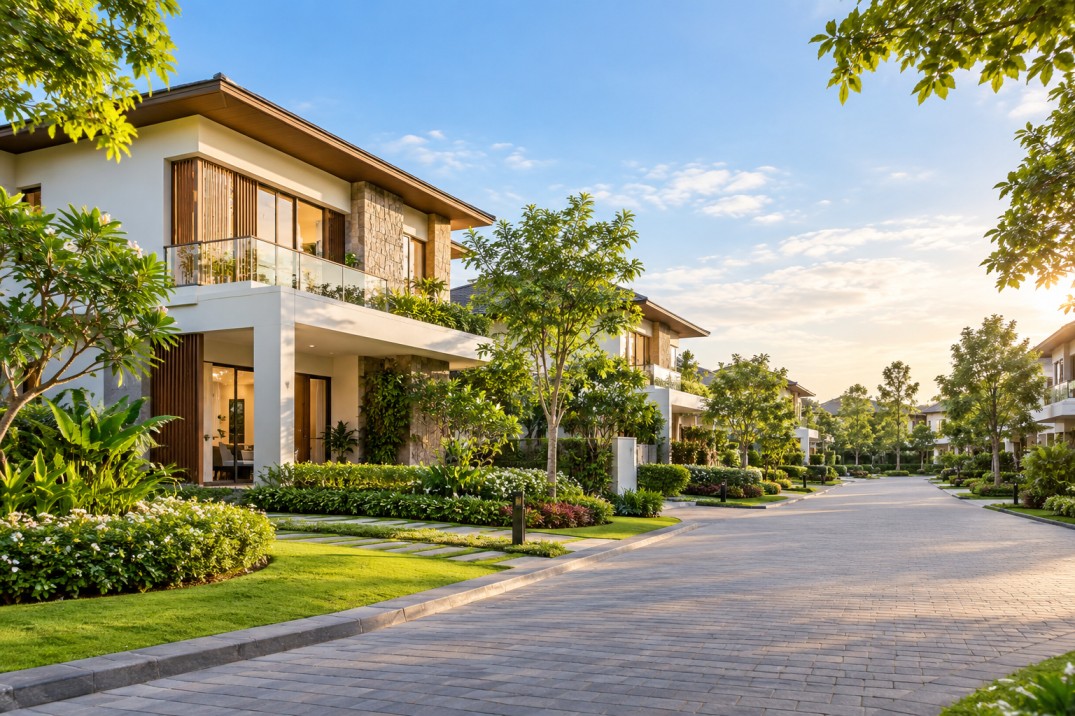
As homebuyers increasingly look beyond the size of a property, the design and planning of the community itself have become important considerations. One concept gaining attention in modern residential development is the low-density villa community.
Unlike high-density developments where a large number of homes may share a relatively compact area, low-density villa communities generally provide fewer residences across a larger land parcel. This approach can create more breathing space between homes, larger landscaped areas, wider internal roads, private outdoor spaces and shared amenities.
For buyers considering a villa as a long-term home, understanding what low-density development means can help them assess whether a particular community matches their lifestyle and priorities.
What Is a Low-Density Villa Community?
A low-density villa community is a residential development where the number of homes built within a given area is relatively limited compared with higher-density housing developments.
The concept is not defined by one universal number of villas per acre. Instead, density depends on factors such as:
- Total land area
- Number of residential units
- Plot sizes
- Built-up area
- Open and landscaped spaces
- Internal roads and pedestrian areas
- Community amenities
- Overall master planning
The objective is generally to create a residential environment where homes and shared spaces are not packed closely together.
For example, a development with fewer villas distributed across a larger site may provide more opportunities for landscaped areas, pedestrian movement, recreational spaces and private outdoor areas than a more tightly planned development.
Why Does Residential Density Matter?
Density affects more than the number of homes in a project. It can influence how residents experience the community every day.
A lower-density layout may provide:
More Open Space
When fewer homes occupy a development, there can be greater scope for gardens, green areas, walking paths, recreational zones and other shared spaces.
Open space can make a residential environment feel less congested and provide residents with areas for outdoor activities.
Greater Privacy
The distance and orientation between homes can influence privacy.
In a thoughtfully planned low-density community, homes may have more separation from neighbouring properties. This can reduce the sense of being surrounded by closely packed buildings.
However, density alone does not guarantee privacy. Villa orientation, boundary walls, landscaping and architectural design also play important roles.
A Less Congested Environment
A lower number of residences can potentially mean fewer vehicles and less movement within the community.
This can be particularly relevant for families with children, older residents or homeowners who value quieter residential surroundings.
The actual experience, however, depends on the project’s road network, parking arrangements, visitor management and overall planning.
Low-Density Villa Communities vs High-Density Developments
Both low-density and high-density residential developments can serve different needs. The choice depends on what a homeowner values.
| Factor | Low-Density Villa Community | Higher-Density Development |
|---|---|---|
| Number of homes | Generally fewer homes across a larger area | More homes within a comparatively compact area |
| Open space | Potentially more room for landscaping and outdoor areas | Space may be distributed among more residents |
| Privacy | Can offer greater separation between homes | Homes may be closer together |
| Community size | Often smaller and more private | Usually accommodates more residents |
| Amenities | May focus on selected lifestyle facilities | Can support a broader range of shared facilities |
| Maintenance | Larger private and landscaped areas may require maintenance | Maintenance may be shared across a larger resident base |
| Cost | Villa communities can have higher purchase and maintenance costs | Apartments can offer more varied price points |
| Social interaction | Smaller communities may feel more intimate | Larger communities can offer a bigger resident network |
Neither approach is automatically better. The right choice depends on budget, family requirements, location, maintenance expectations and preferred lifestyle.
How Does Low Density Affect Family Living?
For families, the design of the surrounding community can be almost as important as the house itself.
Children may benefit from designated outdoor areas and pedestrian-friendly spaces, while parents may value controlled vehicle movement and community security measures.
Older family members may also appreciate walking paths, gardens and seating areas that provide opportunities to spend time outdoors without leaving the residential development.
However, buyers should look beyond the label “low density”. They should examine the actual master plan and understand how much land is allocated to homes, roads, amenities, landscaping and other uses.
The Importance of Green Spaces
Green spaces are an important component of many low-density communities.
Landscaped areas can include:
- Gardens
- Walking trails
- Lawns
- Tree-lined pathways
- Recreational spaces
- Children’s play areas
- Seating areas
- Private gardens
These spaces can improve the visual character of a development while providing residents with places to walk, exercise or relax.
A community with extensive landscaping may also create a stronger connection between residential architecture and its surrounding environment.
However, maintaining large landscaped areas involves ongoing costs. Prospective buyers should understand the maintenance structure and associated charges before purchasing.
Does Low Density Mean Better Privacy?
Not necessarily.
Low density can create the conditions for greater privacy, but the final outcome depends on the design of the development.
Important factors include:
- Distance between villas
- Villa orientation
- Window placement
- Landscaping
- Boundary walls
- Private gardens
- Common-area positioning
- Visitor and vehicle movement
For example, two developments could have similar densities but provide very different levels of privacy because of their architectural layouts.
This is why buyers should visit the actual site rather than relying only on marketing descriptions.
Low Density and Community Amenities
A common misconception is that a low-density community must have fewer amenities.
In reality, the number and type of amenities depend on the developer’s master plan and the size of the project.
A low-density villa community may include facilities such as:
- Clubhouses
- Swimming pools
- Fitness centres
- Yoga areas
- Children’s play areas
- Walking paths
- Sports facilities
- Community gardens
- Multipurpose spaces
The important consideration is not simply how many amenities are available, but how usable they are relative to the number of residents.
An amenity shared among a smaller resident population may offer a different experience from the same facility serving a much larger community.
What Are the Tradeoffs of Low-Density Living?
Low-density development can offer several lifestyle advantages, but there are also potential tradeoffs.
Potential Benefits
More breathing space: Larger areas may be allocated to landscaping and open spaces.
Greater privacy: Homes may have more separation from one another.
Lower perceived congestion: Fewer homes can mean fewer residents and vehicles within the community.
Outdoor-oriented lifestyle: Gardens, walking areas and recreational spaces can become an integral part of daily life.
More spacious planning: The overall community may feel less compact.
Potential Considerations
Higher purchase prices: Villas generally require a larger financial commitment than many apartment options.
Maintenance costs: Larger homes, private gardens and extensive community landscaping can increase maintenance requirements.
Location tradeoffs: Low-density developments often require larger land parcels, which may place them farther from established city centres.
Amenity utilisation: A smaller resident population can affect how certain facilities are operated and maintained.
Infrastructure dependency: Residents may rely more heavily on private vehicles if public transport and nearby services are limited.
These factors should be considered alongside the advantages rather than treating low density as an automatic indicator of a better property.
What Should Homebuyers Check Before Buying?
If low-density living is important to you, consider the following before purchasing a villa.
1. Check the Number of Units
Find out how many villas are planned within the total development area.
2. Understand the Master Plan
Look at how the land is divided between villas, roads, amenities, landscaping and open areas.
3. Visit the Site
A site visit can reveal the actual spacing between homes, road widths, traffic movement and surrounding development.
4. Examine Privacy
Look at the orientation of neighbouring villas, windows, balconies, gardens and boundary treatments.
5. Ask About Maintenance
Understand maintenance charges and what they cover, particularly landscaping, security and common facilities.
6. Check Future Development
Find out whether additional phases, buildings or infrastructure are planned around the community.
7. Evaluate Connectivity
A spacious community may be attractive, but accessibility to workplaces, schools, healthcare facilities, shopping areas and transport infrastructure remains important.
8. Consider Your Long-Term Needs
Think about how the property will work for your family five or ten years from now, rather than evaluating it only as a current purchase.
Low Density vs Location: Which Matters More?
Location and community planning should not be viewed independently.
A low-density villa community in a poorly connected location may not suit someone who needs to commute every day. Conversely, a highly accessible property with limited space may not meet the expectations of a buyer looking for privacy and outdoor living.
The ideal balance depends on the homeowner.
For some buyers, proximity to employment hubs may be the priority. Others may place greater importance on space, greenery, privacy or a quieter environment.
This makes it important to evaluate the entire residential ecosystem rather than focusing on a single feature.
Is a Low-Density Villa Community Right for You?
Low-density living can be suitable for homebuyers who value space, privacy, outdoor areas and a comparatively less crowded residential environment.
It may particularly appeal to families looking for a long-term home where the community itself contributes to their lifestyle.
However, low density should not be treated as a standalone measure of quality. Buyers should evaluate the project’s location, planning, construction quality, amenities, maintenance structure, connectivity, legal documentation and overall suitability.
The best residential choice is ultimately the one that aligns with the buyer’s practical requirements and long-term priorities.
Final Thoughts
A low-density villa community is fundamentally about how homes, people and shared spaces are organised within a residential development.
By providing fewer homes across a larger planned area, such communities can create opportunities for more open space, greater separation between properties and a stronger emphasis on outdoor living.
At the same time, buyers should consider the tradeoffs, including purchase cost, maintenance, connectivity and the practical design of the development.
Rather than choosing a property simply because it is described as “low density”, prospective homeowners should examine the master plan, visit the site and compare the community’s features with their own lifestyle needs.
For anyone exploring villa communities around North Bengaluru, understanding these factors can make the property evaluation process more informed and practical.