


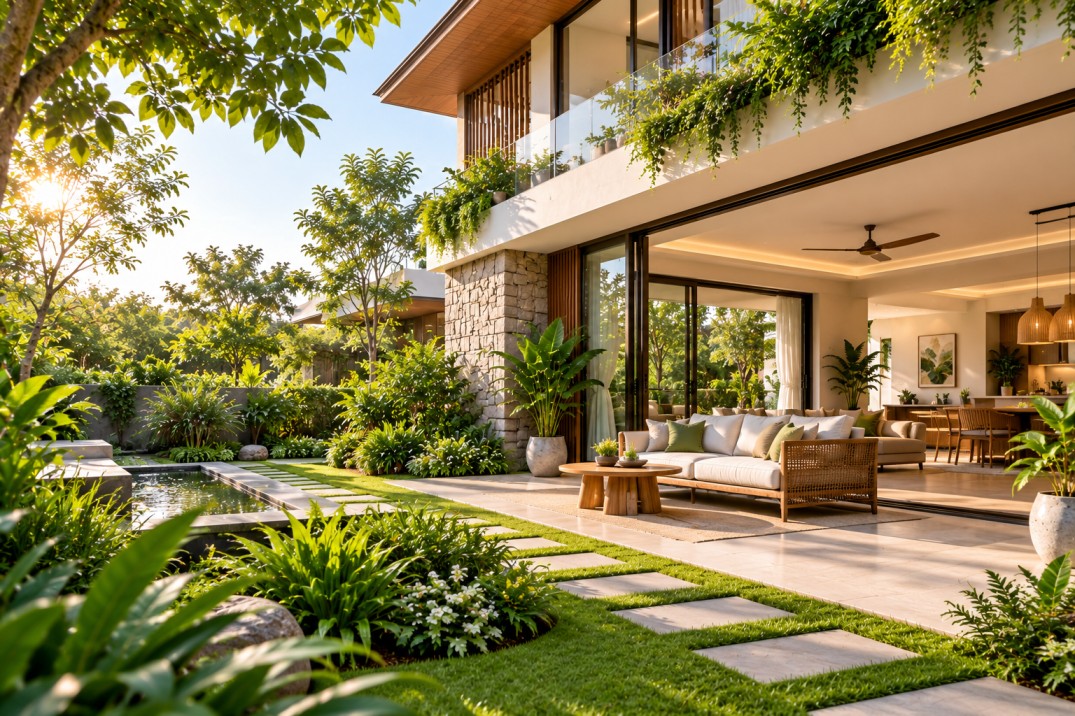
A home is more than its walls, rooms and furnishings. The way a house interacts with sunlight, greenery, air, outdoor spaces and its surrounding environment can influence how people experience everyday life.
This is one reason nature-inspired architecture has become an important consideration in modern villa design. Rather than treating nature as something outside the property, this approach attempts to bring natural elements into the planning, appearance and functionality of the home.
Nature-inspired architecture can take many forms. It may involve large windows that maximise daylight, courtyards that introduce greenery, natural materials such as stone and timber, landscaped gardens, terraces, outdoor living areas or layouts designed around airflow and views.
However, incorporating nature into architecture is not simply about adding plants or using natural-looking materials. Good design requires a balance between aesthetics, functionality, maintenance, climate, privacy and cost.
For villa buyers, understanding these factors can help determine whether a nature-inspired home genuinely supports everyday living or simply looks attractive in photographs.
What Is Nature-Inspired Architecture?
Nature-inspired architecture refers to a design approach that creates a stronger relationship between a building and its natural surroundings.
In residential design, this may involve:
- Maximising natural light
- Encouraging natural ventilation
- Creating visual connections with gardens and landscapes
- Using natural or nature-inspired materials
- Incorporating courtyards and green spaces
- Creating indoor-outdoor living areas
- Designing around existing landscape features
- Using shading and orientation to respond to the local climate
The objective is not necessarily to make a villa look traditional or rustic. A contemporary villa can use glass, concrete and modern finishes while still maintaining a strong connection with nature.
The key consideration is how naturally these elements are integrated into the home’s everyday functionality.
Why Does Nature Matter in Villa Design?
Villas often provide more opportunities for architectural planning than compact urban apartments because they can include private gardens, terraces, balconies, courtyards and larger outdoor areas.
This extra space lets architects create transitions between indoor and outdoor environments.
For example, a living room may open towards a garden through large sliding doors. A bedroom may overlook landscaped greenery. A terrace may extend the living area outdoors.
These connections can change how residents use the home.
Instead of treating the garden as something that is viewed occasionally, the landscape can become part of everyday routines such as having breakfast outdoors, reading in a shaded area, spending time with children or simply opening the doors to allow fresh air into the living space.
Natural Light Can Influence Everyday Living
Natural light is one of the most visible elements of nature-inspired architecture.
Large windows, skylights, clerestory windows and strategically positioned openings can allow daylight to penetrate deeper into a home.
A well-lit interior can feel more open and connected to its surroundings. During the daytime, residents may also have less need for artificial lighting, depending on the orientation and design of the property.
However, more glass is not automatically better.
In warm climates, excessive glazing can increase heat gain if windows are poorly positioned or lack suitable shading. This can increase dependence on air conditioning.
Therefore, effective nature-inspired architecture needs to consider both daylight and solar exposure.
Features such as:
- Deep overhangs
- External shading
- Screens
- Pergolas
- Trees
- Carefully positioned windows
can help balance daylight with thermal comfort.
The goal should be controlled natural light rather than simply maximising the amount of glass.
Ventilation and Airflow
A connection with nature can also influence how a villa handles air movement.
Cross-ventilation is one approach in which openings on different sides of a building allow air to move through internal spaces when outdoor conditions are suitable.
Courtyards, balconies, shaded openings and carefully positioned windows can also contribute to a sense of openness.
However, natural ventilation depends heavily on climate, orientation, surrounding buildings and outdoor air quality.
In a dense or polluted urban environment, simply opening more windows may not always provide the desired result.
This means villa buyers should consider whether the architectural design is actually suited to the local environment rather than assuming that a “natural” design automatically means better ventilation.
Bringing the Outdoors Inside
One of the defining characteristics of nature-inspired villa design is the gradual transition between indoor and outdoor spaces.
Instead of having a clear separation between the house and garden, designers may create intermediate spaces such as:
- Covered verandas
- Courtyards
- Garden-facing living rooms
- Semi-open terraces
- Balconies
- Pergolas
- Outdoor dining areas
These spaces can make the home feel larger without necessarily increasing its built-up area.
A family might use a covered terrace as an informal sitting area, while a garden-facing living room can provide views of greenery throughout the day.
This approach can be particularly relevant for villa communities where landscaping and shared open spaces are part of the wider master plan.
Natural Materials and Their Role
Materials can influence how a villa visually and physically connects with its surroundings.
Stone, timber, clay, brick and other natural or nature-inspired materials can add texture and warmth to contemporary architecture.
For example, a stone feature wall may create a visual transition between a garden and interior space, while timber screens can provide both architectural character and shade.
But material selection involves tradeoffs.
Natural materials may require more maintenance depending on their application and local climate. Timber exposed to weather may need regular treatment, while certain types of stone can require specialised cleaning.
Therefore, the most appropriate material is not necessarily the one that looks the most natural. Durability, maintenance, availability and long-term performance should also be considered.
Landscaping as Part of Architecture
In a nature-inspired villa, landscaping should ideally be considered as part of the overall design rather than as an afterthought.
Trees can provide shade. Planting can soften hard architectural surfaces. Gardens can create privacy, while pathways can connect different parts of the property.
A well-designed landscape can also create different experiences within the same property.
For example, one area could be designed for outdoor dining, another for relaxation and another for children’s activities.
In larger villa communities, landscaped environments can extend beyond individual properties into shared gardens, walking paths and recreational spaces.
This is one area where the principles of low-density villa communities can become relevant, because the relationship between homes and open space depends heavily on the overall amount and distribution of land.
Privacy vs Openness
One of the biggest design challenges in nature-inspired architecture is balancing openness with privacy.
Large windows and open layouts can create beautiful connections with gardens and outdoor spaces. However, they can also expose interiors to neighbouring properties.
This becomes particularly important in villa communities where homes are positioned relatively close to one another.
Architectural solutions can include:
- Strategic window placement
- Landscaping screens
- Boundary planting
- Pergolas
- Vertical fins
- Courtyards
- Changes in floor levels
The objective is to allow residents to enjoy natural views without compromising their sense of privacy.
This is also why buyers should look beyond the individual villa and examine the relationship between neighbouring homes.
Nature-Inspired Design and Family Living
For families, the benefits of nature-inspired architecture can extend beyond visual appeal.
A garden or landscaped outdoor area can provide children with an opportunity to spend time outside without leaving home.
Parents may also benefit from having outdoor areas where they can relax while remaining close to the rest of the family.
For older family members, shaded seating areas, walking paths and easily accessible gardens can make outdoor spaces more usable.
The design should therefore consider how different members of the household will use the property throughout the day.
A beautiful garden has limited practical value if it is difficult to access, receives excessive sunlight or requires more maintenance than the household can reasonably manage.
Sustainability and Resource Efficiency
Nature-inspired architecture can overlap with sustainable residential design, but the two concepts are not identical.
A villa can incorporate natural materials and extensive landscaping while still consuming significant amounts of energy.
True sustainability requires consideration of the building’s broader performance.
Relevant factors may include:
- Solar orientation
- Insulation
- Natural ventilation
- Energy-efficient glazing
- Rainwater management
- Water-efficient landscaping
- Solar energy
- Efficient lighting
- Waste management
- Locally appropriate plant selection
Some of these features may involve higher initial costs but could reduce resource consumption over the long term.
However, homeowners should evaluate the actual performance and maintenance requirements of these systems rather than assuming that a sustainability label guarantees lower operating costs.
The Tradeoffs of Different Nature-Inspired Approaches
There is no single formula for creating a nature-inspired villa. Different approaches involve different benefits and compromises.
| Design Approach | Potential Benefits | Potential Considerations |
| Large windows | More daylight and stronger visual connection with nature | Heat gain, glare and privacy |
| Extensive landscaping | More greenery and outdoor space | Water and maintenance requirements |
| Natural materials | Warm, tactile appearance | Cost and maintenance may vary |
| Open-plan interiors | Greater sense of space and connection | Less acoustic and visual separation |
| Courtyards | Privacy, greenery and outdoor connection | Requires careful planning and usable space |
| Large terraces | Flexible outdoor living | Weather exposure and maintenance |
| Natural ventilation | Reduced reliance on mechanical cooling when conditions permit | Dependent on climate and air quality |
| Water features | Visual and sensory appeal | Water use, cleaning and maintenance |
This illustrates why nature-inspired architecture should be evaluated as a complete design strategy rather than by individual features.
Does Nature-Inspired Architecture Always Mean More Space?
Not necessarily.
A smaller villa can still have a strong relationship with nature if its spaces are thoughtfully planned.
A compact courtyard, balcony garden, green wall or well-positioned window can create a connection with the outdoors without requiring a very large plot.
Similarly, a large villa can feel disconnected from nature if its windows face neighbouring walls, its outdoor areas are poorly planned or the landscape is treated as an afterthought.
This means the quality of the relationship between architecture and nature can be more important than the overall size of the property.
The Importance of Climate-Responsive Design
Nature-inspired architecture should respond to its location.
A design that works well in a cool climate may not be suitable for a warm and humid environment. Similarly, a villa designed for heavy rainfall may require different roof forms, drainage and landscaping compared with a property in a dry region.
Climate-responsive considerations can include:
- Building orientation
- Sun path
- Prevailing winds
- Rainfall
- Humidity
- Temperature
- Vegetation
- Shading requirements
For buyers exploring villas in North Bangalore, for example, it is useful to assess how the architectural design responds to the local climate rather than judging the property only by its visual appearance.
How Community Planning Extends Nature-Inspired Living
Nature-inspired living does not stop at the boundary of a villa.
In a thoughtfully planned residential community, shared landscaping, walking paths, gardens and recreational spaces can contribute to the overall living experience.
This creates a wider relationship between private and shared environments.
For example, a villa may have its own garden or terrace, while the larger community may provide landscaped walking routes and common outdoor spaces.
This approach is increasingly visible in modern villa communities in North Bangalore, where community planning can combine private residences with landscaped surroundings and shared amenities.
However, buyers should examine the actual master plan, maintenance structure and usable open space rather than relying solely on terms such as “green community” or “nature-inspired development”.
What Should Homebuyers Look For?
If nature-inspired design is important to you, consider the following before purchasing a villa.
1. Observe Natural Light
Visit the property at different times of day if possible. Check which rooms receive direct sunlight and whether shading is adequate.
2. Examine Ventilation
Look at the location of windows and openings. Consider whether the layout supports cross-ventilation where appropriate.
3. Check Outdoor Spaces
Assess whether gardens, terraces, balconies and courtyards are genuinely usable rather than simply decorative.
4. Understand Maintenance
Ask who is responsible for landscaping and how much private outdoor space will require ongoing maintenance.
5. Look at Privacy
Check the position of neighbouring villas, windows, balconies and outdoor areas.
6. Consider Water Requirements
Extensive landscaping may require irrigation. Ask how water management and maintenance are handled.
7. Evaluate Materials
Look beyond appearance and understand the durability, maintenance requirements and expected lifespan of exterior materials.
8. Study the Master Plan
The surrounding community can influence your experience just as much as the villa itself.
9. Consider Future Changes
Think about whether surrounding construction, additional phases or changes in landscaping could affect views, sunlight or privacy.
10. Visit the Property
Photographs and architectural renders cannot fully communicate how a home feels throughout the day. A site visit remains important.
Nature-Inspired Architecture vs Conventional Villa Design
Conventional villa design is not necessarily disconnected from nature.
Many traditional and contemporary homes already use courtyards, verandas, gardens, shaded windows and natural ventilation.
The difference is often the extent to which these elements are integrated into the overall design.
A conventional approach may prioritise internal floor space, visual aesthetics and functional requirements.
A nature-inspired approach may place greater emphasis on the relationship between those spaces and the surrounding environment.
Neither approach is automatically suitable for every homeowner.
A buyer who prioritises minimal maintenance may prefer a simpler landscape. Someone who enjoys gardening and outdoor living may value extensive green spaces.
The right design therefore depends on lifestyle, climate, budget and long-term expectations.
Can Nature-Inspired Design Improve Everyday Villa Living?
Nature-inspired architecture can influence everyday living by changing how residents interact with their homes.
A garden-facing living room can provide a changing view throughout the day. A shaded terrace can create another place to relax. Natural daylight can alter the atmosphere of interior spaces, while thoughtful ventilation can make certain rooms feel more comfortable when outdoor conditions permit.
These effects are often subtle rather than dramatic.
The value of nature-inspired architecture may therefore come from the accumulation of small design decisions rather than one defining architectural feature.
Final Thoughts
Nature-inspired architecture is ultimately about creating a meaningful relationship between a home and its natural surroundings.
Natural light, ventilation, landscaping, outdoor spaces, materials and climate-responsive planning can all contribute to this relationship. However, each approach involves tradeoffs involving cost, maintenance, privacy, energy use and practicality.
For villa buyers, the most important question is not whether a property looks “natural”, but whether its design genuinely improves the way the home can be used.
A well-designed villa should balance indoor comfort with outdoor connection, private spaces with community environments, and aesthetic appeal with practical performance.
As residential developments continue to evolve, the idea of living close to nature is likely to remain relevant for homeowners seeking a more connected and considered approach to everyday villa living.