


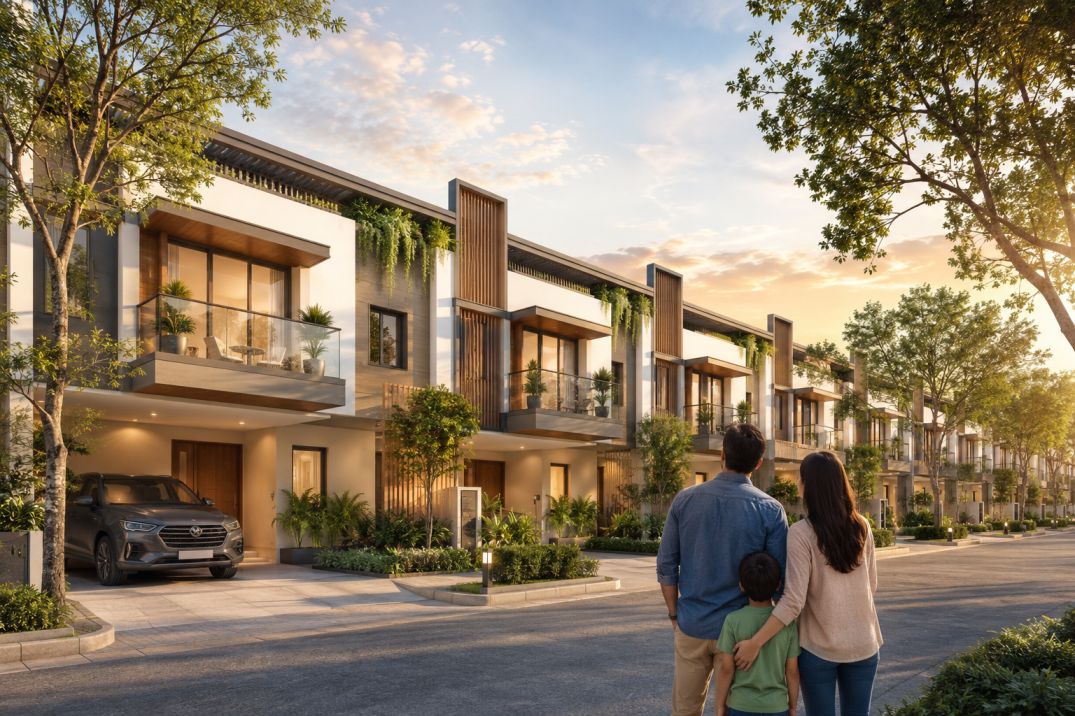
Buying a home is one of the biggest financial decisions most people ever make – and when that home is a row villa, the stakes get even more specific. Unlike apartments, row villas blend the privacy of an independent house with the community feel of a gated layout. But that hybrid nature is exactly why so many buyers get confused about how to choose a row villa that actually fits their lifestyle, budget, and long-term goals.
This guide is built as a complete row villa buying guide for 2026 – covering location intelligence, legal due diligence, construction quality, resale value, and a step-by-step decision framework you can actually use, not just read.
What Is a Row Villa?
A row villa (also called a row house or twin villa, depending on configuration) is an independent housing unit built in a continuous row, sharing side walls with neighboring units but offering its own entrance, floor plan, and often a small private garden or terrace. It sits between an apartment and a standalone bungalow – offering more privacy and land ownership than a flat, with lower maintenance and cost than a fully detached villa.
Reputed developers such as SVAM Realty focus on designing row villas that combine modern architecture, functional layouts, green spaces, and community living, making them an attractive choice for today’s homebuyers.
Key entities associated with row villas that matter for search and for your decision-making:
- Builder/Developer reputation
- RERA registration
- Gated community amenities
- Land title and khata type (A or B)
- Floor Space Index (FSI) and setback compliance
- Resale and rental yield potential
Why Row Villas Are Gaining Popularity in 2026
Post-pandemic buyer behaviour permanently shifted toward more private, low-density living. According to industry data from Knight Frank and Anarock’s 2025-26 residential reports, independent and row-house formats in India’s top metros saw double-digit demand growth as buyers prioritised private outdoor space, better ventilation, and reduced shared-wall density compared to high-rise apartments.
In cities like Bangalore, this shift is visible in the growing number of row villa projects launching in peripheral growth corridors – particularly in North Bangalore, driven by proximity to the airport, IT corridors, and upcoming infrastructure like the Peripheral Ring Road.
How to Choose a Row Villa: The 7-Point Framework
If you’re wondering how to choose a row villa without getting overwhelmed, use this framework. It’s the same checklist experienced real estate consultants use with clients.
1. Location and Connectivity
Don’t just check today’s connectivity – check 2030 connectivity. Look at:
- Distance to workplace hubs and IT parks
- Upcoming metro lines or ring roads
- Proximity to schools, hospitals, and daily-need retail
- Airport/highway access if you travel frequently
2. Builder Track Record
Research at least 3 completed (not just launched) projects by the same builder. Visit one in person if possible. Check Google reviews, RERA complaint history, and handover timelines from past projects.
3. Legal and Title Verification
This is the single most-skipped step by first-time buyers. Always verify:
- RERA registration number
- A-Khata status (not B-Khata, which limits loan and resale options)
- Encumbrance Certificate (EC) for the last 15-30 years
- Approved building plan matching actual construction
4. Construction Quality and Specifications
Compare the builder’s specification sheet (flooring, plumbing brand, electrical fittings, waterproofing) against what’s actually delivered in a sample unit or a completed phase.
5. Community Design and Density
Row villas vary hugely in density. Some layouts have 40-50 units with wide setbacks; others cram 150+ units tightly. Lower density generally means better privacy, ventilation, and long-term appreciation.
6. Amenities That Match Your Lifestyle
Don’t pay a premium for a clubhouse you’ll never use. Prioritise amenities based on your actual routine – walking tracks, kids’ play areas, security infrastructure, and parking convenience matter more day-to-day than a rarely-used banquet hall.
7. Exit and Resale Potential
Ask: If I needed to sell this in 7 years, who would buy it, and at what appreciation range? Row villas near established social infrastructure and transit tend to hold value better than those in far-flung, amenity-poor pockets.
Row Villa Buying Guide: Step-by-Step Process
This section of the row villa buying guide walks you through the actual transaction sequence, from shortlisting to registration.
Step 1 – Budget and Loan Pre-Approval
Get a loan pre-approval before shortlisting. It tells you your real budget ceiling and speeds up negotiation once you find the right unit.
Step 2 – Shortlist 4-6 Projects
Use the 7-point framework above to shortlist. Avoid falling in love with the first project you see – comparison is where the real clarity comes from.
Step 3 – Site Visits (Multiple Times, Different Times of Day)
Visit each shortlisted project at least twice – once on a weekday morning and once on a weekend evening – to understand traffic, noise, and neighbourhood activity patterns realistically.
Step 4 – Document and Legal Review
Hire an independent lawyer (not the builder’s recommended one) to review the sale agreement, title documents, and RERA filings.
Step 5 – Negotiate and Understand Payment Schedule
Understand whether it’s a construction-linked plan or a possession-linked plan, and negotiate on floor rise, corner unit premiums, and inclusions – not just the base price.
Step 6 – Registration and Handover
Verify khata transfer, occupancy certificate (OC), and completion certificate (CC) before final registration and possession.
Best Row Villas in North Bangalore: What to Look For
North Bangalore has emerged as one of the most active corridors for row villa development, driven by airport connectivity, IT hubs like Manyata Tech Park and Kirloskar Business Park, and infrastructure upgrades along the Peripheral Ring Road. If you’re evaluating the best row villas in North Bangalore, prioritize projects near:
- Established arterial roads (Bellary Road, Hennur-Bagalur Road, Thanisandra Main Road)
- Reputed schools and hospitals within a 5-10 km radius
- Builders with at least one completed, occupied phase (not just a launch)
- RERA-approved layouts with clear A-Khata titles
A well-located row villa in North Bangalore with strong legal documentation and moderate density tends to outperform larger, denser projects further from social infrastructure – both in livability and long-term appreciation.
Choosing the Right Villa: Common Mistakes to Avoid
Even experienced buyers make avoidable errors when choosing the right villa. Watch for these:
- Prioritizing price over documentation – a cheaper unit with unclear title is not actually cheaper long-term.
- Ignoring maintenance costs – ask for the actual monthly maintenance figure, not the builder’s optimistic estimate.
- Skipping the sample unit inspection – brochures and 3D renders rarely match final finishing quality.
- Not checking flood/drainage history – especially relevant in low-lying pockets during monsoon season.
- Underestimating floor rise and orientation impact – east/north-facing corner units often carry premiums but also better resale value.
Quick Comparison: Row Villa vs Apartment vs Independent House
| Factor | Row Villa | Apartment | Independent House |
| Privacy | High | Moderate | Very High |
| Maintenance Cost | Moderate | Low-Moderate | High |
| Land Ownership | Yes (proportionate/full, project-dependent) | No (undivided share only) | Yes (full) |
| Community Amenities | Yes | Yes | Rarely |
| Resale Liquidity | Moderate-High | High | Moderate |
| Customization | Limited-Moderate | Very Limited | Full |
Conclusion
Selecting the ideal row villa requires a careful assessment of location, design, construction quality, amenities, legal compliance, and long-term investment potential. Buyers who take the time to evaluate these factors systematically are more likely to secure a property that delivers both lifestyle satisfaction and financial value.
As demand for premium villa communities continues to rise across North Bangalore, partnering with trusted developers becomes increasingly important. SVAM Realty has established a reputation for creating thoughtfully planned residential environments designed for modern homeowners seeking comfort, connectivity, and long-term growth potential. If you are exploring premium villa living, reviewing well-planned developments and consulting experienced professionals can help you move closer to finding your dream home.
Frequently Asked Questions (FAQs)
Check the RERA registration number on your state’s RERA portal, confirm A-Khata status, and get an Encumbrance Certificate covering at least the last 15 years before proceeding.
A row villa shares side walls with adjacent units in a continuous row, while a duplex villa typically refers to a two-floor standalone or semi-attached unit with fewer shared walls.
Row villas in well-connected, low-density layouts with clean documentation have shown consistent demand growth, driven by post-pandemic preference for private, low-rise living – though returns vary significantly by location and builder credibility.
This varies by project size and amenities, but always request the actual current monthly maintenance figure from existing residents rather than relying on the builder’s projected estimate alone.
Ready-to-move units eliminate construction-delay risk and let you inspect actual quality, while under-construction units often offer lower entry pricing – the right choice depends on your risk tolerance and urgency of possession.
At minimum: RERA certificate, approved building plan, Occupancy Certificate (OC) or Completion Certificate (CC), Encumbrance Certificate, and a lawyer-reviewed sale agreement.